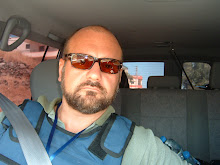
I visited Quibdó during my last RSA mission in Colombia in 2007. The town of Quibdó is the district capital of Chocó in the north west of Colombia. The region has some of the worst national indicators in terms of poverty, malnutrition, illiteracy, maternal and child health. The regional capital, Quibdó, shelters more displaced persons per capita – tens of thousands of them – than any other population centre in Colombia.
Along the banks of the nearby Atrato, San Juan and Baudó rivers, hundreds of thousands of mainly Afro-Colombians and indigenous civilians are trapped in the web of war. The armed gangs who control the waterways do not allow them to fish, hunt or gather wood. The district is of great strategic importance to both government and armed groups alike due to its proximity to, and border with Panama and the Pacific coastline. The area is heavily used for the illegal trafficking of drugs, weapons, people and other contraband items. The terrain is very harsh with mountains and thick jungle in abundance. The road infrastructure consists of only two access routes into the region from the east. The main form of transportation is by the complex river network. Visitors to the region are advised to only travel on essential business and by air only.
The district has experienced high levels of violence over recent years between the paramilitaries, guerrillas, bandits and government forces. There has been an escalation in these clashes over the last two years as a result of Colombian military pressure in the region. Whilst the town of Quibdó itself is under government control, all other parts of the district are considered extremely dangerous as various armed groups struggle for control in the region.
Whilst there are no formal agreements in place and delivery missions are frequently stopped at illegal checkpoints (often our boat was stopped during navigation in the river), there have been very few incidents of antagonism, violence against staff or theft. It should be borne in mind that, as the military continue to increase the pressure on these groups both in action and logistically, the area can face up an escalation of violence.
Supplies cargos have been stopped by illegal military actors as well as government armed forces apparently to avoid that the shipment could end in the hands of guerrilla.
The phenomenon of displacement of people in this area is massive. Huge areas of wooden and cellophane made houses surround Quibdó’ town. Colombian displaced people have crossed the border to Panama looking for a better future.
The two most important ethnic communities in the area are the Afro-Colombian and the autochthonous indigenous populations. Both of them are conducting a “Pacific Resistance” to guerrilla which forces them to leave their native locations. They passively resist until illegal armed groups start taking actions, killing people. They are forced to share their space with terrorists. Both communities have a territory legally recognized by the State of Colombia.
THE THREAT
The main external threat in Chocó district remains that of domestic terrorist activity. The major internal risk to personnel is river travel and its associated hazards.
The risk of domestic terrorist actions is assessed as high (there may be cross over in this threat area to organized crime).
There is an identified threat to international staff working in the Chocó’ region. This is primarily due to the threat of kidnapping, as westerners are generally seen as a more valuable target than local nationals. The presence of international staff can significantly alter the security profile of an operation.
ORGANIZED CRIMINAL ACTIVITIES:
There is a high level of organized crime in Colombia as a whole and in Chocó in particular. Affluent nationals and international personnel in particular are targeted for robbery and/or kidnappings. There are many illegal armed groups operating in the Chocó district including FARC, ELN, paramilitaries and local criminal gangs. There is little law and order outside of the urban centers. The armed groups are under continuous pressure from both the military and each other and resources in the region are scarce, leading to potential threat to operations. Very few outsiders visit the region and seldom venture out of Quibdó. The threat of organized criminal activity is assessed as high. Two Army Brigades specialized in antiterrorism and counter-guerrilla are settled in town and have recently attacked guerrilla troops in the area of S. Juan (rural area).
MEDICAL EMERGENCY:
Medical facilities are rudimentary. There is a hospital in Quibdó which offers basic emergency services on a pre payment basis. There are no medical facilities outside of the main towns and very poor means of evacuation from mission areas. The risk of not receiving adequate medical attention at the Quibdó in is assessed as high.
 RIVER TRAVELS:
Travel is dangerous. At least 600 people have been killed in the last few years according to the main Afro-Colombian Association, ACIA.
The requirement to travel by river presents some unique risks to the Quibdó operation. There are many diseases present in and around the river areas, including tuberculosis, pulmonary pathologies, diarrhea and yellow fever. A large amount of debris floating on and submerged in the river water can put at risk navigation and is often very difficult to see. This includes dead trees and sunken boats and creates a major hazard to river traffic. The risk of injury or severe illness as a result of river travel is assessed to be high.
I would call the Quibdó Region the hidden treasure in Colombia for its natural beauty and it geographical structure.
The requirement to travel by river presents some unique risks to the Quibdó operation. There are many diseases present in and around the river areas, including tuberculosis, pulmonary pathologies, diarrhea and yellow fever. A large amount of debris floating on and submerged in the river water can put at risk navigation and is often very difficult to see. This includes dead trees and sunken boats and creates a major hazard to river traffic. The risk of injury or severe illness as a result of river travel is assessed to be high.
I would call the Quibdó Region the hidden treasure in Colombia for its natural beauty and it geographical structure.